













CONTACT:
KEY TERMS: RELATED INFORMATION:
|
Reference: 03-1438
Client:
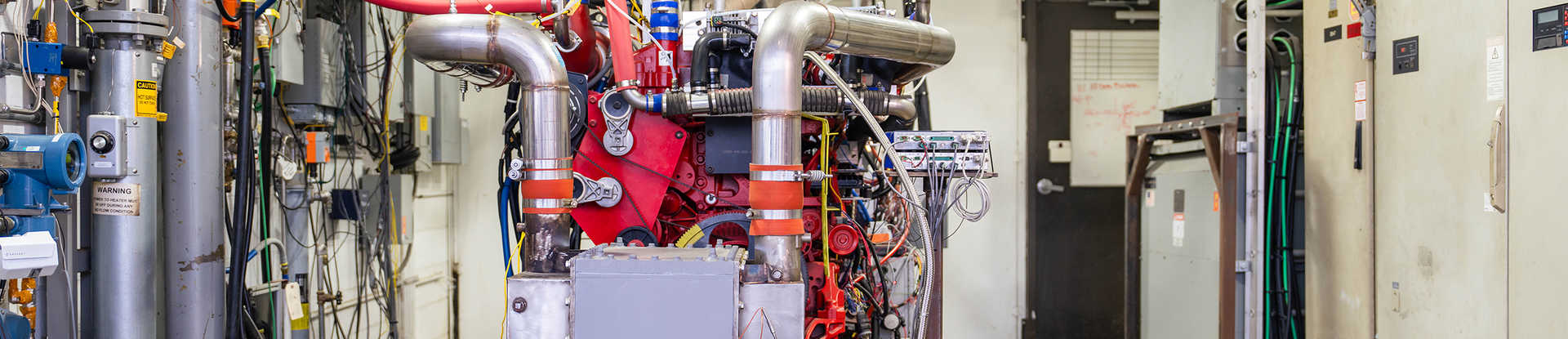
U.S. Department of Energy Duration: Sixteen Months Objective:Evaluate how ethanol may be used for improved efficiency of spark-ignition engines while maintaining very low emissions and to demonstrate some of those improvements on the DOE/NREL/SwRI Ultra-Low Emissions Vehicle (ULEV), a modified 1993 Ford Taurus with a 3.0-liter V-6 engine. Approach:Computer simulations were used to estimate brake thermal efficiencies and fuel efficiencies of various engine concepts. Because of the very high octane number of ethanol (>100), high compression ratios are possible, increasing thermal efficiency significantly. A number of modifications were made to the engine and vehicle to first reduce emissions to ULEV levels and to improve the efficiency. These changes include the following: The OEM engine/vehicle control system was replaced with an SwRI® Rapid Prototyping Electronic Control System (RPECS) to allow complete flexibility in changing engine and aftertreatment hardware and control strategies. The compression ratio was increased from 9.3:1 to 12.0:1 to take advantage of the high octane number of Ed85 (85% denatured ethanol/15% gasoline), increasing efficiency about 8% compared with the baseline engine.
Accomplishments:The 1993 Ford Taurus demonstrator vehicle met ULEV emissions over the U.S. FTP-75 urban cycle with efficiency equal to OEM vehicle:
Computer modeling has shown three other engine technologies that look particularly attractive for high-efficiency, low-emissions, ethanol-fueled, spark-ignition engines: Direct-injected, lean-burn/stoichiometric engine. Because the heat of vaporization of ethanol is 2.4 times that of gasoline and the octane number is in excess of 100, compression ratios of about 15:1 are possible with direct-injection, giving optimized efficiency for a spark-ignition engine. Lean-burn combustion is used for high efficiency, and stoichiometric combustion for high power. Direct-injected, high-EGR, stoichiometric engine. Using excess EGR instead of excess air allows a "lean-burn" engine to be operated at a stoichiometric air/fuel ratio, permitting the use of 3-way catalysts to give low NOx emissions, a technology that is not possible under lean-burn conditions. Small-displacement, supercharged engine. Most light-duty engines are operated at road-load powers of 10 hp or so for most of their operating time, with relatively poor efficiencies because of the very high throttling losses. Reducing the engine displacement allows an engine to be operated at the same power with reduced throttling losses, while the addition of a supercharger allows recovery of power equivalent to the larger displacement, naturally aspirated engine. Ethanol, with its very high octane number (>100), permits the use of a supercharger without reducing the compression ratio, while a gasoline fueled engine would exhibit knock under the same conditions. For further information, please contact Lee Dodge Related Publications:SAE Paper 970531, "Model-Based Control and Cylinder-Event-Based Logic for an Ultra-Low Emissions Vehicle," by D.M. Leone, L.G. Dodge, K.R. Shouse, J. Grogan, and R.W. Weeks, 1997. SAE Paper 981358, "Development of an Ethanol-Fueled Ultra-Low Emissions Vehicle," L.G. Dodge, K. Shouse, J. Grogan, D.M. Leone, K.A. Whitney, and P.M. Merritt., 1998. Southwest Research Institute Final Report, "Development of a Dedicated Ethanol Ultra-Low Emissions Vehicle," Lee G. Dodge, Timothy J. Callahan, Joseph Grogan, Douglas M. Leone, David W. Naegeli, Kenneth R. Shouse, Robert H. Thring, Kevin A. Whitney, January, 1998. Please browse this web site to see the full capabilities and experience of SwRI and the Engine, Emissions & Vehicle Research Division. Then give us an opportunity to become an extension of your engineering department. E-mail Charles Roberts or call him at (210) 522-5521 for more information. Engine, Emissions & Vehicle Research Division Southwest Research Institute® (SwRI®), headquartered in San Antonio, Texas, is a multidisciplinary, independent, nonprofit, applied engineering and
physical sciences research and development organization with
11 technical divisions. |
||||||||||||||||||||||||||